
The Fire that Changed Everything
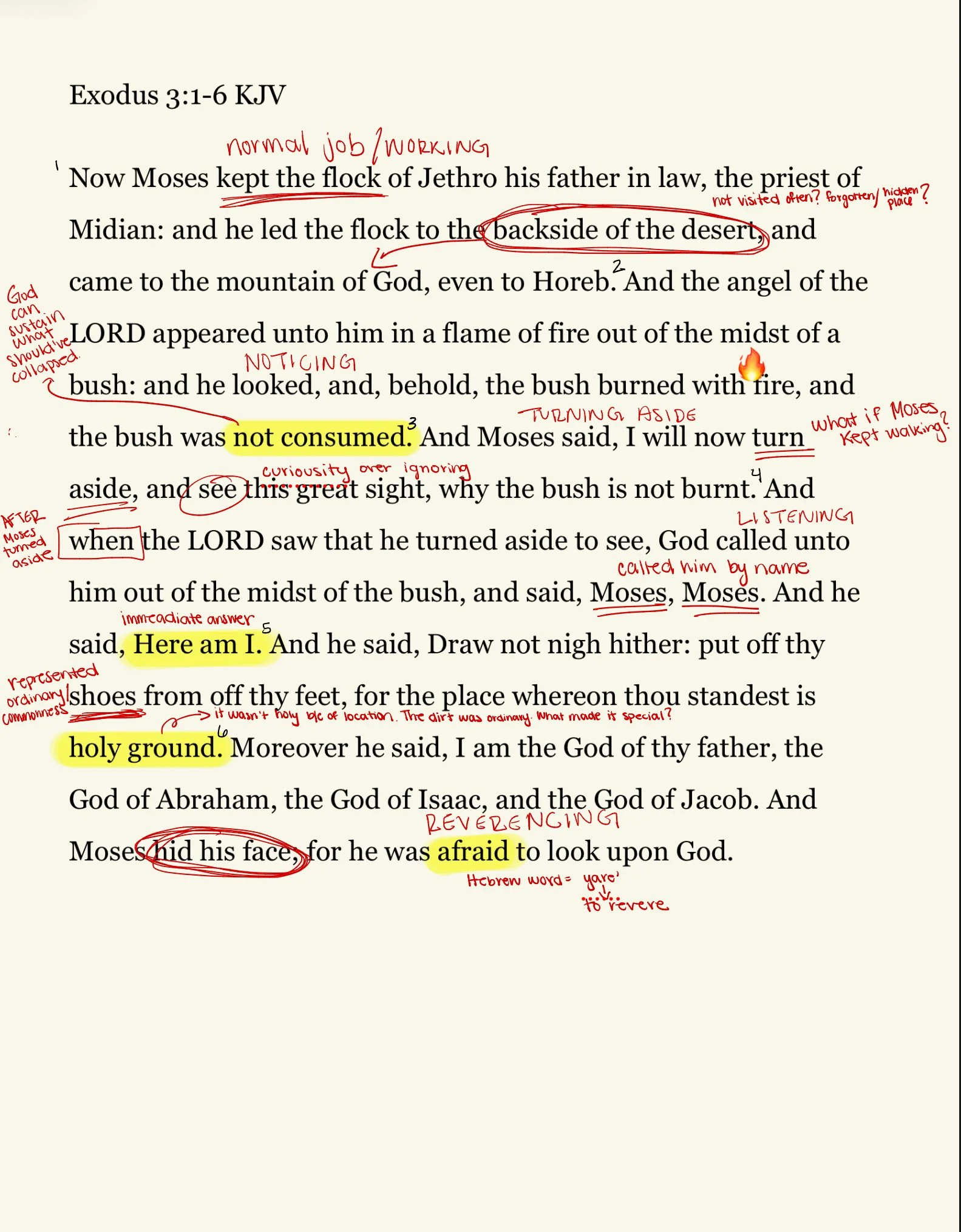
Sunshiiine’s annotations
Fire usually means something is ending.
A house fire.
A forest fire.
A burning photograph in the bottom of a trash can.
Most fires arrive carrying destruction in their hands.
But in Exodus 3, the fire was different.
It burned, but it did not consume. It interrupted an ordinary workday in the wilderness. And somehow, hidden inside a bush in the middle of the desert was the beginning of freedom.
Before Pharaoh released the children of Israel, the plagues, and the Red Sea splitting open, there was a man named Moses standing still long enough to notice a burning bush.
The miracle was not that the bush was burning, but rather that it survived the flames. Fire wasn’t a foreign concept at this point in the world, but this fire carried presence and purpose.
This fire carried a calling large enough to pull an entire nation out of bondage.
One fire.
One moment of attention.
One conversation in the wilderness.
And generations would never be the same.
Verse 1
Question: Where does God meet Moses?
Moses isn't praying, preaching, or performing miracles. He's working.
The text says Moses "kept the flock" and led it to the "backside of the desert." This wasn't a crowded place. It was hidden, ordinary, and likely overlooked by most people. Yet it was there that Moses came to "the mountain of God, even Horeb."
The first lesson of the passage is simple: God's presence is not limited to extraordinary places. Moses encountered God in the middle of an ordinary workday. Sometimes we assume God only moves in sanctuaries, conferences, or life-changing moments. Exodus 3 reminds us that He is just as present in the wilderness as He is in the promised land.
Verse 2
Question: Why didn’t the bush burn up?
The text highlights something unusual: the bush was burning, but it was “not consumed.” That detail is the miracle. Fire normally destroys. It reduces things to ash. Yet this bush remained standing in the middle of the flames.
Perhaps, this is one reason God chose fire as the sign. His presence is powerful enough to transform without destroying. The same God who would preserve Israel through slavery was demonstrating preservation through a bush.
Verse 3
Question: What made Moses stop?
Moses says, “I will now turn aside, and see this great sight.”
The fire caught his attention, but his decision to investigate changed everything.
What if Moses had dismissed it?
What if he had decided he was too busy with his flock?
What if he had simply kept walking?
The passage suggests that curiosity became the doorway to encounter. Moses was willing to pause long enough to examine what God was doing. Sometimes the difference between experiencing God’s providence or presence and missing it is whether we’re willing to turn aside.
Verse 4
Question: When did God speak?
The answer is hidden in a single word: “when.”
“And when the Lord saw that he turned aside to see, God called unto him…”
God called after Moses turned aside. The text doesn’t say God spoke while Moses was walking away. It says God spoke when Moses gave his attention.
Then God called him by name. “Moses, Moses.” This wasn’t a generic announcement. It was personal. And Moses responded immediately: “Here am I.”
Attention became conversation. Conversation became calling.
Verse 5
Question: What made the ground holy?
God tells Moses to remove his shoes because he is standing on holy ground. But what changed?
A moment earlier it was ordinary desert dirt. The location itself wasn’t famous either. There was no temple, altar, or busy city. The difference was God’s presence. The ground became holy because God was there. What Moses stood on had not changed. Who stood before him had.
When God is present, ordinary places become sacred spaces, and it requires a change in pace. It requires respect.
Verse 6
Question: Why did Moses hide his face?
The passage says Moses was afraid to look upon God. The Hebrew word used here points beyond terror. It carries the idea of awe, reverence, and deep respect. Moses began his encounter curious about a burning bush. Now he finds himself overwhelmed by the holiness of God. The man who approached to investigate a mystery is not covering his face in worship. He recognizes the shift in the atmosphere.
Read the passage one final time and notice the movement.
In verse 1, Moses is working.
In verse 2, he is noticing.
In verse 3, he is turning aside.
In verse 4, he is listening.
In verse 5, he is conversing.
In verse 6, he is reverencing.
That progression is what makes this fire so significant. The burning bush was never merely a miracle to observe. It was an invitation to move closer to God. Before Moses would lead a nation out of bondage, God first led Moses through a journey of his own…routine to revelation and reverence.
One fire.
One moment of attention.
One conversation in the wilderness.
And generations would never be the same.
- Sunshiiine ☀️